
Quick answer: what a good sensor order looks like
A door and window sensor is a cheap device that carries an expensive amount of regulation. A sound wholesale order therefore comes down to five decisions, in order: the wireless protocol and whether a gateway is required, the app and ecosystem your customers already use, the battery and its safety and transport paperwork, the certification your destination market demands, and only then price and quantity. Importers who reverse that order — price first, compliance last — are the ones who end up with a pallet that cannot clear customs or a channel full of returns from customers who never owned a hub.
What you are actually buying
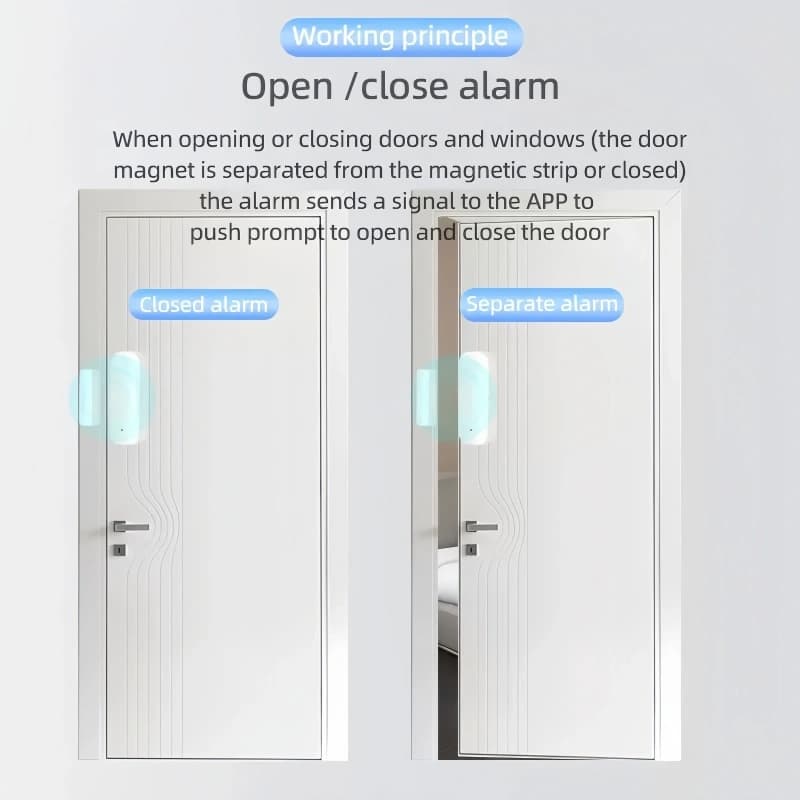
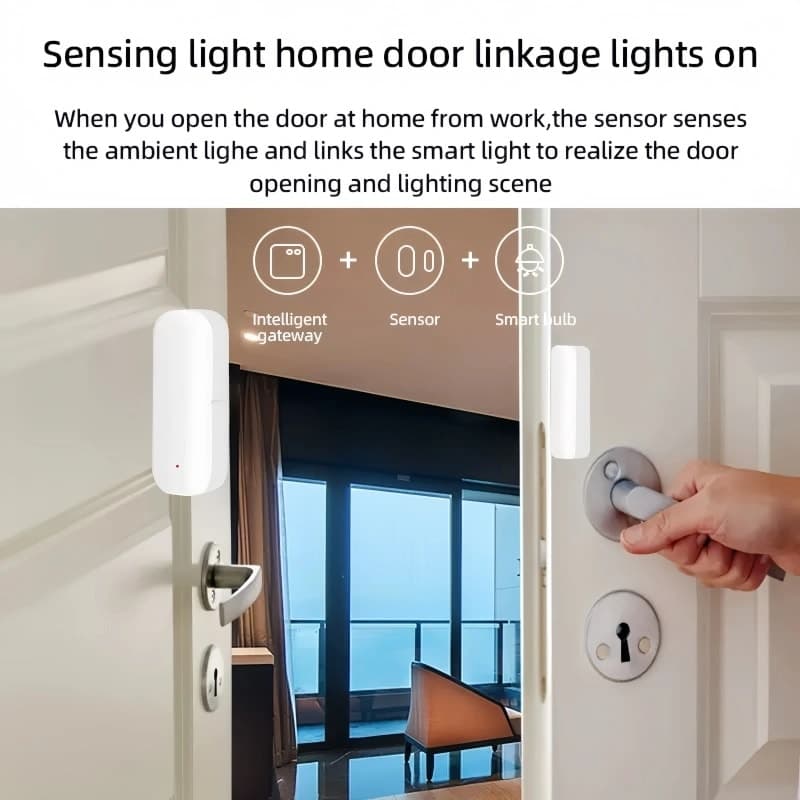
A smart door and window sensor (also sold as a contact sensor or entry sensor) is a two-part magnetic device: a sensor body on the frame and a magnet on the moving door or window. Separating the two changes the reported state, which triggers a push notification and any automation the user has configured. There is almost no mechanism to fail, so quality differences show up somewhere less obvious — radio reliability, battery life, adhesive that survives a hot window frame, and firmware that reconnects cleanly after a power cut.
Commercially, the category is attractive precisely because it is small, light and cheap to ship, and because buyers rarely purchase just one. The catch is that a sensor is only useful inside an ecosystem, so you are not selling a standalone product — you are selling one node of a system your customer may or may not already own.
The gateway question (read this first)
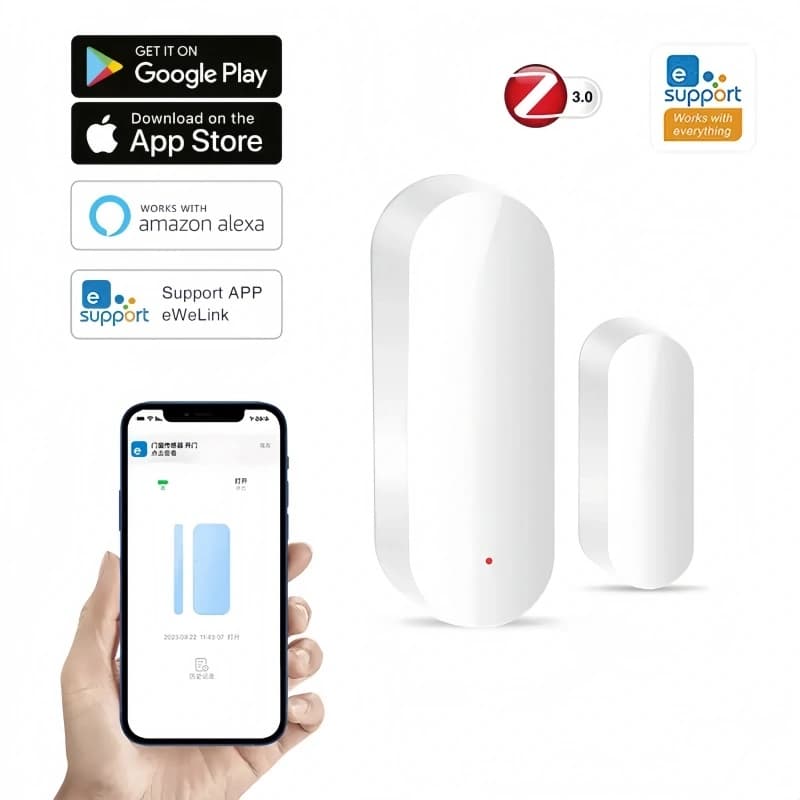
This is the single most expensive thing to get wrong, so it belongs before any discussion of price. Zigbee and Thread sensors cannot connect to a Wi-Fi router directly. They speak a low-power mesh protocol and need a gateway (hub) to bridge them to the internet and to the app. Our own sensors run Zigbee 3.0 and require a compatible Zigbee gateway.
That is a technical footnote to an engineer and a business model to a buyer. If you sell into a channel where customers already own a hub — a smart-home ecosystem, an installer network, a security dealer — the gateway requirement is a non-issue and the mesh gives you better battery life and range. If you sell to general e-commerce customers who own nothing, a bare Zigbee sensor generates support tickets and returns, and the fix is to bundle a gateway, sell a starter kit, or state the requirement in the first line of the listing rather than in the specification table.
Choosing the protocol
For battery-powered contact sensors the practical field narrows quickly. Wi-Fi is convenient because it needs no hub, but keeping a Wi-Fi radio available drains a small cell far faster than a low-power mesh radio, which is why Wi-Fi is common in mains-powered devices and rare in contact sensors. Zigbee 3.0 is the volume default: mature, low power, globally usable on one 2.4 GHz SKU, and cheap at the module level. Thread offers similar power behaviour with IP addressing and pairs with Matter for cross-ecosystem support, at the cost of a border router. Z-Wave runs on region-specific sub-GHz frequencies, which means separate SKUs and separate approvals per region.
The short version for a first order is that Zigbee 3.0 is the safe default and everything else is a deliberate exception. For the full side-by-side — node ceilings, SKU counts, certification burden and what each protocol does to your landed cost — see our protocol comparison for bulk buyers.
The specs that decide quality
Sensors are easy to make badly because the failures are invisible on a spec sheet. These are the fields worth pinning down in writing before you sample:
| Field | What to ask for | Why it matters in bulk |
|---|---|---|
| Protocol & version | Zigbee 3.0 (not legacy Zigbee HA) | Version drives gateway compatibility and returns |
| Detection gap | The magnet separation distance that triggers a state change | Too tight and misaligned frames report false opens |
| Battery & rated life | Cell type plus the tested life and its assumptions | Battery complaints dominate reviews and returns |
| Adhesive | Grade and tested temperature range | Failing tape on a sunlit window frame is a warranty claim |
| Reconnect behaviour | What happens after a gateway reboot or power cut | Silent drop-off is the most damaging failure mode |
| Ecosystem route | Which app, and whether Alexa/Google support is native or via the app | Determines what you may legally claim on the listing |
Our sensors are specified as Zigbee 3.0 with eWeLink app support and Amazon Alexa and Google Assistant compatibility, adhesive-mounted with no wiring, in a minimalist glossy white enclosure. For a deeper field-by-field checklist to run against any supplier’s datasheet, see our smart sensor spec comparison.
Battery, safety law & shipping
The battery is the part of a contact sensor most likely to create a compliance problem, and it is routinely overlooked because the device itself seems trivial.
- Button-cell child safety.The United States tightened the rules on consumer products containing button or coin cells following Reese’s Law, with requirements around secured battery compartments, warnings and packaging tied to the UL 4200A standard. If your model uses a coin cell, treat this as a design input, not a label change, and confirm the current requirements with the test lab for your ship date.
- Transport documentation. Lithium cells need UN38.3 test documentation and a safety data sheet to move by air or sea. Missing paperwork strands shipments at the forwarder, which is an avoidable and expensive delay.
- Rated life versus real life. A quoted battery life is meaningless without the reporting interval and open/close frequency behind it. Ask for the assumptions and make sure they resemble how your customers will actually use the device.
MOQ, cost drivers & packaging
Smart-home MOQ starts at 1 piece per model — genuinely one — because sensors are built on existing tooling and stocked electronics rather than a bespoke mould. That is unusual in hardware and you should use it: sample a single unit, put it on a real door for a fortnight, and check the reconnect behaviour before you commit to a container.
We do not publish a fixed per-unit price band for sensors, because unlike a tent the cost is dominated by choices rather than by size. The drivers that actually move the number are the radio module and chipset, the battery and enclosure, whether you need a custom PCBA or custom tooling, the certification set you require and how it amortises over your volume, and the retail packaging. Send the specification and target market and we will come back with a quotation against it. Payment runs 30% deposit with the balance against a copy of the bill of lading, and samples take about 10–15 days.
On packaging, decide early whether you are shipping bulk-packed units for an installer channel or full retail boxes for shelf and e-commerce. Retail packaging carries its own artwork, barcode and regulatory-marking work, and it is far cheaper to design it once, before production, than to relabel afterwards.
Certification that gates import
A door sensor contains an intentional radio transmitter, so it needs equipment authorisation in every market you sell into. This is not the same as the general product safety marking many importers assume covers it:
| Market | Radio authorisation | Also check |
|---|---|---|
| United States | FCC Part 15 equipment authorisation | Button-cell rules (Reese's Law / UL 4200A), Prop 65 in California |
| European Union | CE under the Radio Equipment Directive (RED) | RoHS, REACH, WEEE registration, GPSR |
| United Kingdom | UKCA marking | UK REACH-equivalent chemical rules, WEEE |
Two practical points that catch first-time importers. First, radio approval attaches to the radio and antenna design — change the module and the approval generally has to be redone, so a mid-life component swap is a certification event, not a purchasing detail. Second, where lab testing sits on the critical path it can add roughly a month, so the certification plan belongs at the start of the project. Our facilities run to ISO 9001, ISO 14001 and BSCI management systems with formal certification currently in application, and we arrange the product testing pathway per order against your destination market.
The sourcing workflow
Run the order in this sequence and each step removes risk from the next:
- 1Fix the ecosystemDecide the protocol, the gateway story and which apps and voice platforms you will claim.
- 2Write the specProtocol version, detection gap, battery and rated life with assumptions, adhesive grade, enclosure.
- 3Lock certificationAgree the radio authorisation and battery paperwork for your market before tooling or firmware work.
- 4Sample on a real door10–15 day sample; test range through walls, reconnect after a gateway reboot, and adhesive in heat.
- 5Produce with in-line QCPairing and range checks during the run, not only a functional test on the finished batch.
Production sits in a 7,000 m² facility running 10 production lines with an annual capacity of roughly 180,000 pieces, so scaling from a sample to a repeat container order does not mean moving to a different factory.
Common mistakes to avoid
- Selling a hub-dependent sensor to hub-less customers. The most common and most expensive error in this category. Bundle a gateway or say so loudly.
- Assuming a general safety marking covers the radio. Radio equipment needs its own authorisation. Budget for it per SKU and per market.
- Overlooking the coin cell. Button-cell child-safety requirements and UN38.3 transport paperwork are design and logistics inputs, not afterthoughts.
- Accepting a battery-life number with no assumptions. Without a reporting interval and usage pattern the figure is marketing, not a specification.
- Not testing reconnect behaviour. A sensor that quietly fails to rejoin after a router reboot produces one-star reviews that no amount of unit cost saving repays.
Key takeaways
- Decide the gateway story before the price — hub dependency drives returns more than any spec.
- Zigbee 3.0 is the volume default for battery contact sensors; treat anything else as a deliberate exception.
- Smart-home MOQ starts at 1 piece per model, so there is no excuse for skipping a real-world sample.
- Radio authorisation (FCC / RED / UKCA) plus button-cell and UN38.3 paperwork gate import — plan them first, not last.
- Pin battery life, detection gap and reconnect behaviour in writing; they decide your review scores.
Frequently Asked Questions
What is the MOQ for wholesale smart door and window sensors?
Smart-home MOQ starts at 1 piece per model, because sensors are built on existing tooling and stocked electronics rather than a custom mould. That makes evaluation cheap — you can sample a single unit before committing. Custom enclosures, a custom PCBA or your own branded app raise the minimum, since tooling and firmware work carry their own economics. Tell us the customisation level for an exact figure.
Do smart door and window sensors need a hub or gateway?
Zigbee and Thread sensors do — they are not Wi-Fi devices and cannot talk to a router directly, so a compatible gateway bridges them to the internet and the app. Our Zigbee 3.0 sensors require a Zigbee gateway. This matters commercially: if your channel sells sensors to customers who own no hub, you must either bundle one or state the requirement prominently, or you will absorb the returns.
Which certifications do smart door and window sensors need?
Because they contain a radio, they need equipment authorisation per market: FCC Part 15 for the United States, CE under the Radio Equipment Directive for the EU, and UKCA for the United Kingdom, plus RoHS and REACH for materials. Coin-cell models also fall under US button-cell child-safety rules, and lithium cells need UN38.3 documentation to ship. We arrange the testing pathway per order for your destination market.
How long do smart sensor samples and production take?
Samples run about 10–15 days. A repeat production order on existing tooling and an already-certified radio is considerably faster than a first run, because certification is the long pole — where lab testing sits on the critical path it can add roughly a month. Lock the certification plan before tooling or firmware work starts, not after.
Can I sell smart sensors under my own brand?
Yes. The usual routes are your logo and retail packaging on an existing model, a custom enclosure on the same certified electronics, or a fully custom PCBA and your own app. Each step up adds tooling, firmware and re-certification cost — changing the radio or antenna generally means the radio approval must be redone. Our private-label smart home playbook covers the trade-offs.
What battery do door and window sensors use and how long does it last?
Most contact sensors run a coin cell or a small lithium cell, and on a low-power protocol like Zigbee 3.0 a well-designed sensor lasts far longer than a Wi-Fi equivalent, which is why Wi-Fi is rarely used for battery contact sensors. Actual life depends on the cell, the reporting interval and how often the door is opened, so ask for the tested figure and the assumptions behind it rather than accepting a headline number.
Explore Our Smart Door & Window Sensors
Ready to move from research to a quotation? Send us your specification and target market — our team comes back with MOQ, lead time and pricing.