
Rain Jacket or Rain Suit: Choosing a Retail Range
Compare rain jacket vs rain suit wholesale range roles: separate coverage, jacket-and-trouser sizing, retail units, packing and version-specific evidence.
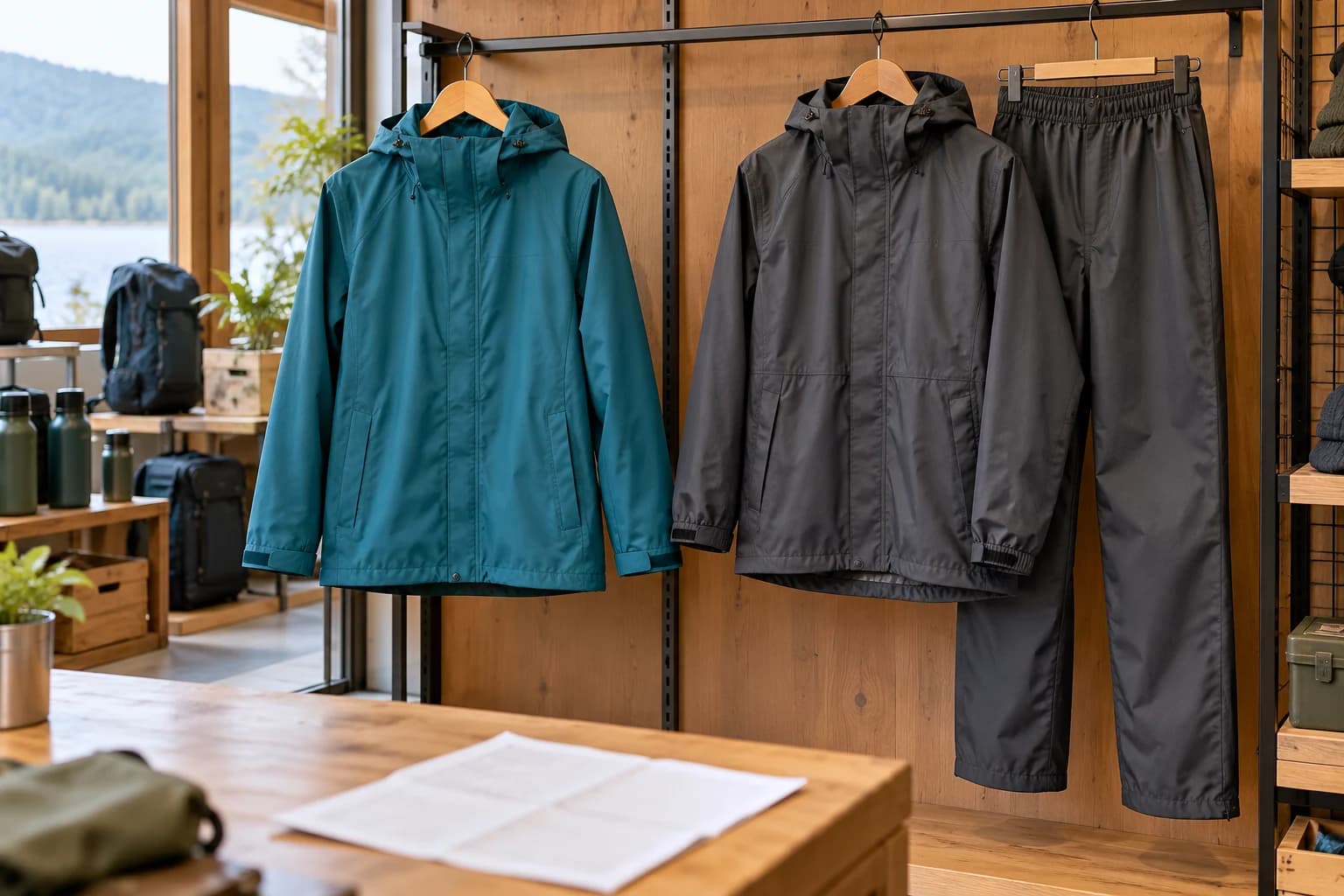
AI-generated editorial cover, not exact Seawing products, a real shop, customer, order or performance demonstration.
Define two retail units before comparing features
This guide is for outdoor retailers and category buyers building a rainwear assortment. SKU 42 is a hiking-jacket reference with supplier-described three-layer construction. SKU 45 presents a hooded jacket and trousers with a matching storage-bag presentation. Keep the product identifiers separate even when the colours look similar. A shared category does not establish matching materials, sizing, aftercare or performance.
A jacket can fill an upper-body outer-layer position where the customer already owns suitable lower-body clothing. A set offers a coordinated jacket/trouser retail unit, but the buyer must check the offered contents and both pieces' fit. Describe these as potential range roles, not guaranteed suitability for every activity. For walking, commuting or travel briefs, record duration, layering, footwear and how the customer expects to put the garment on.
SKU 45's supplied images contain 180 g, 200 g and 300 g references across different presentations. Do not assign the lightest number to a complete set or treat the values as one product's weight range. Request a version/size/lining/piece-count mapping and the weighing scope. The same discipline applies to a photograph showing ventilation: an opening can be identified without turning it into a breathability rating.
- SKU 42: jacket reference; its supplied construction description remains specific to that record.
- SKU 45: jacket-and-trouser set reference with storage-bag presentation.
- Choose exact options and confirm set contents, measurements and evidence independently for each SKU.
Jacket versus set: a retail decision table
The table compares decisions, not tested performance. Ask the supplier to answer each column for the actual offered revision.
| Decision | Jacket reference: SKU 42 | Set reference: SKU 45 | Buyer acceptance question |
|---|---|---|---|
| Coverage / range role | Upper-body garment | Jacket plus trousers | Which clothing gap and customer activity should this unit address? |
| Sizing / layering | Chest, sleeve, length and adjustment measurements | Jacket measurements plus waist, rise, inseam and leg opening | Can both pieces fit the intended shopper over specified layers? |
| Dressing access | Hood, cuffs, front and pocket closures | Jacket access plus trouser waist and ankle entry | Can the labelled sample be put on with the intended footwear? |
| Packing / sale unit | Confirm garment and any included items | Confirm both pieces, bag and size pairing | Is the retail label, contents list and barcode mapped to this unit? |
| Claims / documentation | Revision-specific construction and care records | Separate jacket/trouser scope and set care review | Which exact claims and market documents does the evidence support? |
Choose the unit, then the customer task
An upper-body outer layer; record the lower-body clothing the customer would supply separately.
A coordinated sale unit; verify both pieces, size pairing, contents and dressing sequence.
Compare evidence and shelf needs for each revision; no automatic winner on weight or protection.
A set image and a separate jacket view
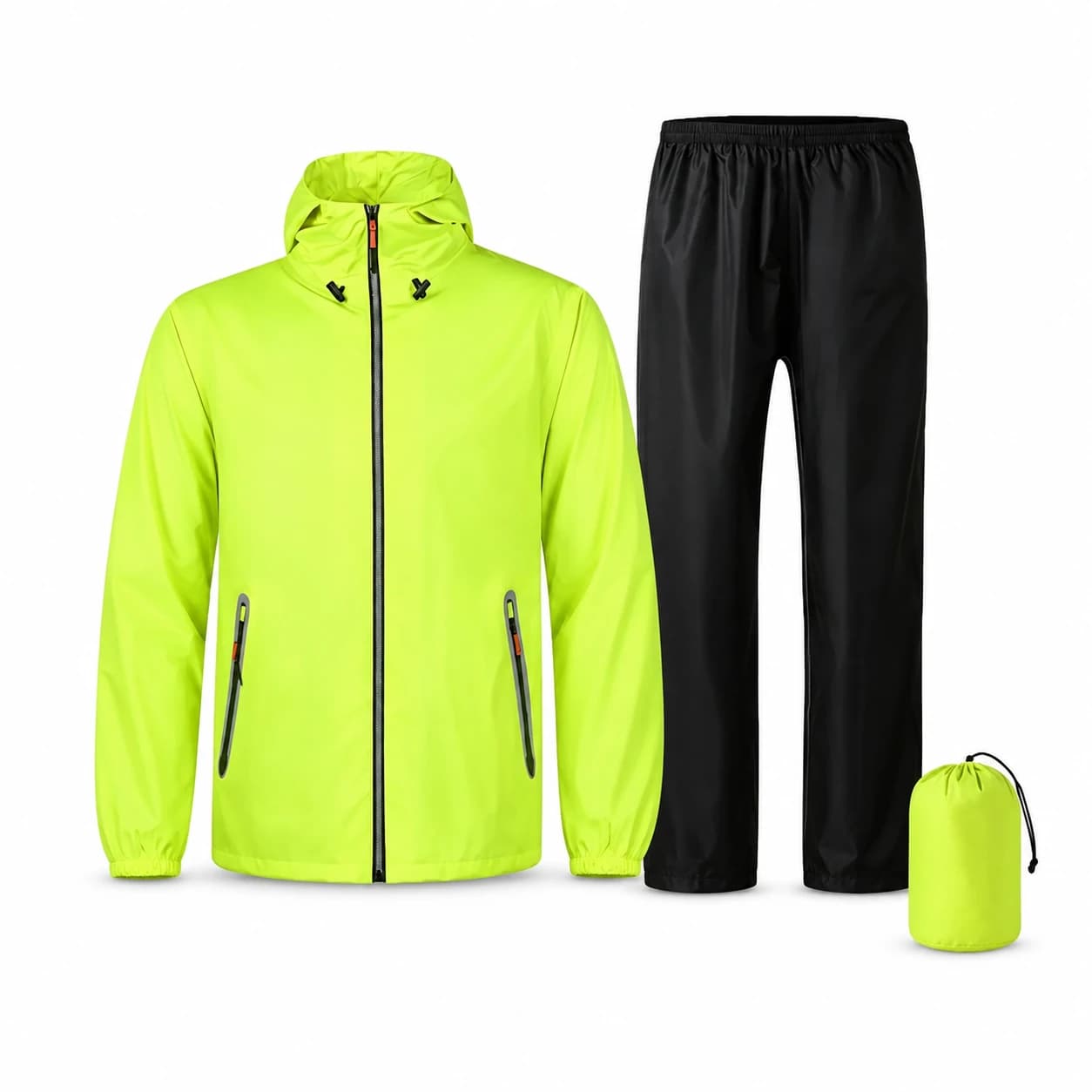
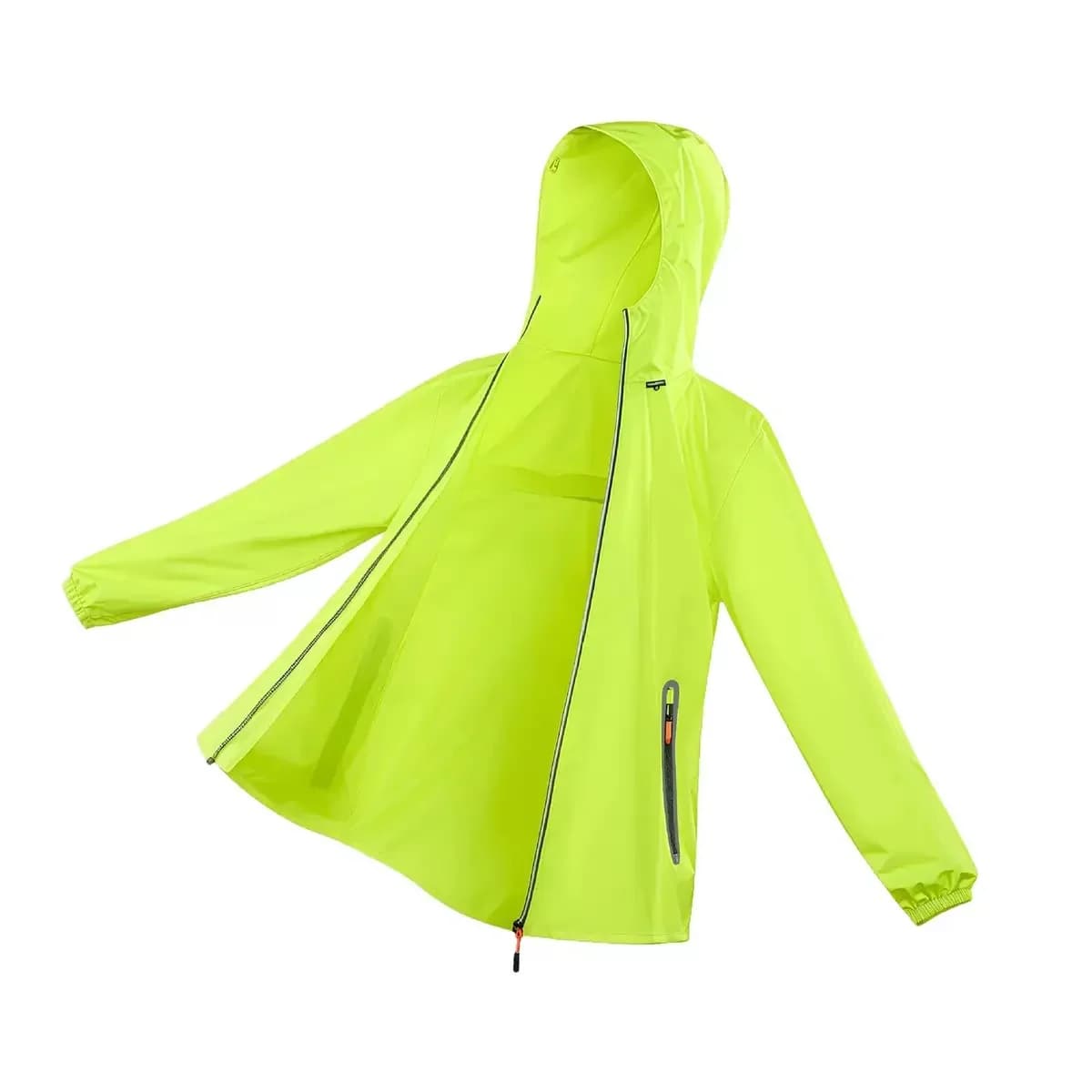
The first site catalogue photo shows SKU 45's jacket, trousers and bag presentation. The second independently photographed open jacket helps identify the garment format; it is not a second complete-set photo or proof of its hidden materials. The AI cover is generic editorial range imagery, not these exact products.
Prepare a version-specific range handoff
Do not ask only for a rainwear price list. Send a row for each proposed retail unit and keep shopper needs distinct from supplier commitments. Where top and bottom sizes differ, ask whether the offered set can accommodate that pairing; do not promise mix-and-match availability. Packaging and barcode requests also need a confirmed scope rather than an assumed customisation service.
| Buyer requirement | Supplier record to request | Retail decision |
|---|---|---|
| Market, channel, activity and quantity per unit | Exact SKU, option, revision and offered contents | Which shelf role is being evaluated? |
| Customer layers and intended body-size range | Garment measurements, tolerances and top/bottom pairing | Which sizes can be listed with supported advice? |
| Putting on, taking off and carrying | Closure/entry sample, packed dimensions and weighing scope | Is the handling sequence suitable for the stated brief? |
| Retail presentation | Contents list, bag, label artwork, barcode and packing proposal | Does one sale unit match one identified record? |
| Claims and destination-market review | Per-piece construction/care records and applicable documents | What wording may be approved for that version? |
Five steps to a defensible rainwear range
- 1Name the customer taskDescribe activity, layers, footwear, market and sales channel.
- 2Choose the retail unitCompare one jacket with an explicitly defined jacket/trouser set.
- 3Request version dataCollect measurements, contents, packing and separately scoped evidence.
- 4Check labelled samplesReview movement, dressing access, size pairing and the proposed care information.
- 5Approve range rowsFreeze supported descriptions, offered units and document revisions before shelf publication.
Use activity guides as questions, not SKU verdicts
REI's selection guide explains consumer shell and activity choices. Gemplers organises rainwear around exposure, closures, ventilation and other features. Both help a buyer identify comparison fields; neither tests SKU 42 or 45. Their material rankings, preferred products and exposure recommendations cannot decide which Seawing version belongs in a range. A jacket-and-trouser format alone does not prove greater waterproofness or a particular use classification.
FTC textile and care-label guidance is US-specific; GINETEX provides a care-information framework. Keep fibre/identity information, care instructions and performance evidence as separate review items. For a set, ask whether care information applies to both pieces and how each piece is identified if separated. Destination-market reviewers should assess label, chemical and other applicable documents against the exact products. This page provides an assortment brief, not legal advice or a compliance finding.
Original sources reviewed October 22, 2026
Compare the rainwear records and send a range brief
Open the apparel category and shortlist the exact SKU 42 and 45 options. Send market, channel, quantity per retail unit and the version-specific matrix. A rain jacket vs rain suit wholesale decision is ready for discussion when contents, size pairing, packing and evidence are linked—not when two photographs simply look complementary.
Frequently Asked Questions
Is a rain suit always better than a jacket?
No. The format changes the clothing coverage and retail unit, not automatically the tested performance. Compare the customer's activity and the selected versions' evidence before deciding their shelf roles.
Can both pieces use the same size label?
Do not assume that a shared size name proves a fit pairing. Request jacket and trouser measurements, measurement methods and offered pairing options for that exact set.
Does the lowest pictured weight apply to the complete set?
Not necessarily. SKU 45 imagery contains several presentation-specific weight references. Ask which size, lining and pieces each number includes, with the weighing method, before publishing a set weight.
What should be checked when the customer wears boots?
Request the trouser leg-opening and closure details, then review dressing access on the labelled sample with the intended footwear. A photograph cannot establish compatibility for all boots.
Can the jacket's report be used for the trousers?
Only if the report explicitly covers the relevant trouser version and claimed property. Keep materials, seams, care history and specimen scope separate; sharing a set name does not extend a report.
What should a range enquiry contain?
Include exact SKUs/options, market, channel, customer activity, quantity per sale unit, size-pairing questions, contents and packaging needs. Request version-linked construction, care and applicable market documents.