
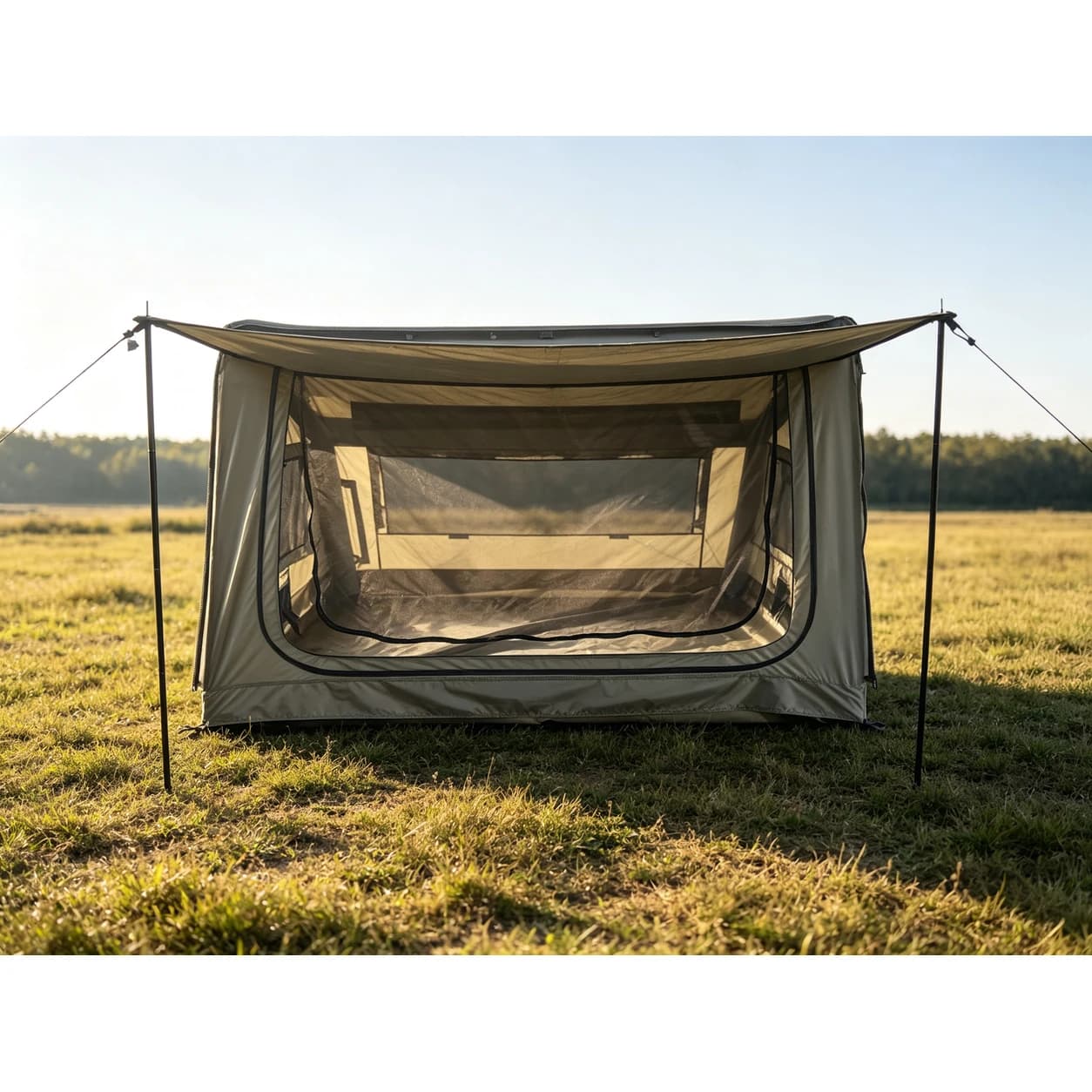
Compact Sleep-Pod Tents: Site and Customer Fit
Turn a compact sleep-pod tent record into a site brief: separate listed size, usable interior, access, anchoring and operator requirements before choosing a version.
Existing supplier catalogue photographs identify the SKU 54 reference. Images and dimension labels do not establish performance, included contents, usable space or project approval.
Start with the low-profile SKU 54 record
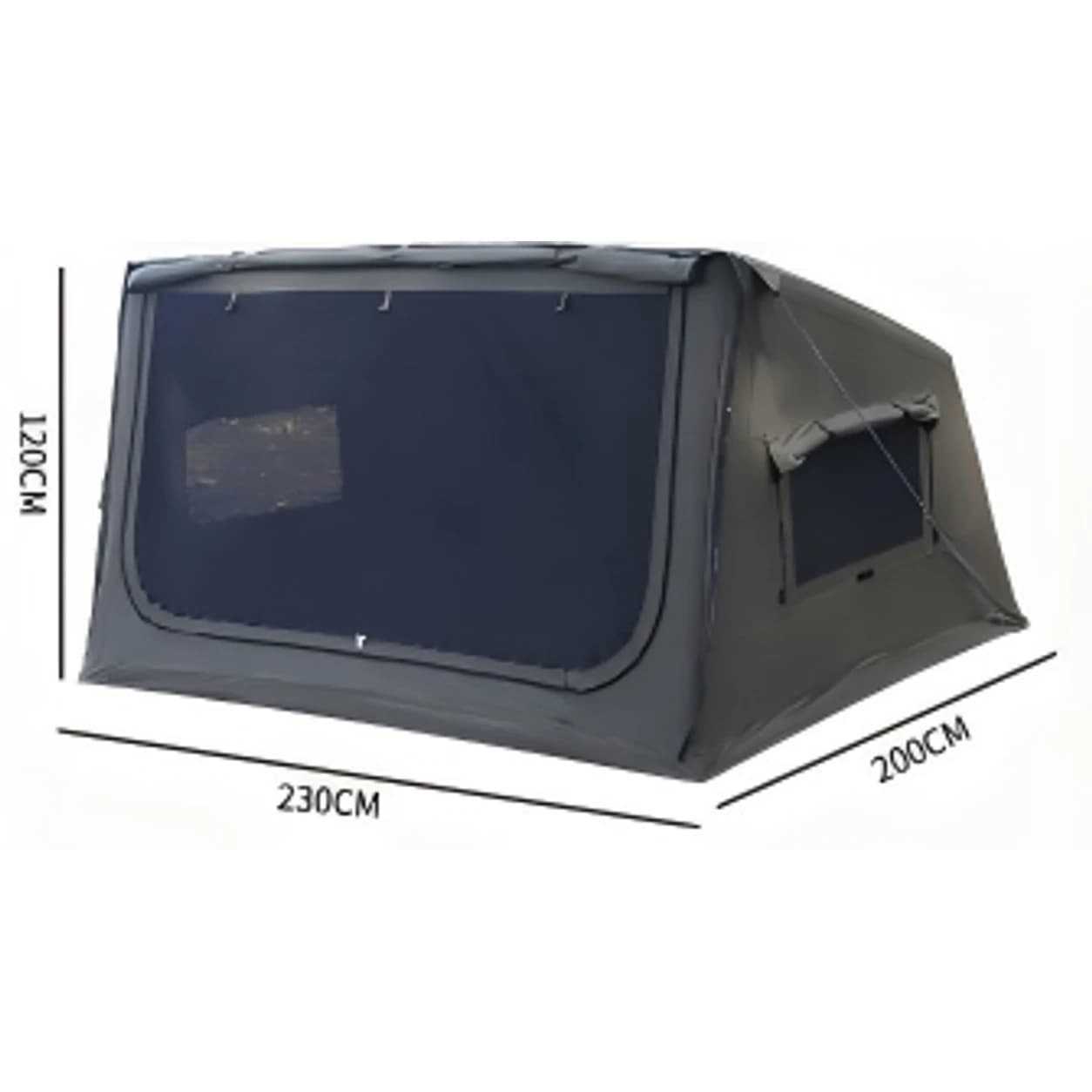
This guide is for campsite, event and accommodation project buyers converting a product reference into a site-specific brief. SKU 54 is recorded as a compact sleep-pod tent with listed size 230 × 200 × 120 cm, floor-area label 4.6 m², green or khaki colours and fabric labelled 420D PU3000 Oxford. Keep that fabric wording as a catalogue descriptor. It is not, by itself, a complete-tent waterproof result, certification or statement of suitability for a project.
The arithmetic 2.30 m × 2.00 m equals 4.60 m². This reconciles the listed rectangular dimensions with the catalogue area label; it does not measure a usable inner floor or establish room for people and belongings. Wall slope, inner boundaries, doors, components and operating state need separate records. Likewise, the listed 120 cm dimension should not become a standing-height or wearer-height promise.
Begin with the task to assess: a retail demonstration, a proposed campsite sleeping unit or another buyer-described setting. These are questions to investigate, not approved uses of SKU 54. Write down who will operate the shelter, what must pass through the opening, what sleeping equipment is proposed and which operator requirements apply. If those requirements cannot be reconciled with version-specific evidence, keep the reference unselected rather than making the site fit the product name.
- SKU 54 catalogue size: 230 × 200 × 120 cm; listed area: 4.6 m².
- Published descriptors: 420D PU3000 Oxford; green or khaki. No test or certification is inferred from this label.
- Interior usable measurements, entry clearance, fully pitched/anchored footprint and a confirmed contents list require their own version-linked records.
Five proposed tasks to screen before selection
These are buyer scenarios to assess, not approved SKU 54 uses. Keep the stock catalogue reference separate from a bespoke tent-development request.
| Proposed task | Starting point | Evidence needed | Selection boundary |
|---|---|---|---|
| Retail demonstration | Low-profile SKU 54 reference | Access sequence, display outline and assembly instructions | A demonstration proposal does not prove the product suits an overnight customer. |
| Campsite sleeping unit | Published envelope and area label | Actual equipment layout, full pitch and operating record | Hold selection until sample and operator requirements are reconciled. |
| Repeated relocation | A catalogue record, not a setup-time claim | Packed dimensions, weight, parts and assembly method | Do not promise portability or quick setup without version-specific evidence. |
| Assisted entry or movement | Listed height is not entry clearance | Clear opening, required manoeuvres and competent review | Do not infer accessibility from a photograph. |
| Accommodation operation | A product reference, not a permission | Applicable product documents and site/services review | Keep product selection separate from operator and authority approval. |
Keep envelope, layout and site separate
The published size identifies the record. It is not a measured inner floor or a complete pitch.
Actual equipment outlines and operation determine the questions to check on a sample.
Circulation, anchoring and applicable site requirements remain a separate project assessment.
Read the catalogue photographs within their scope
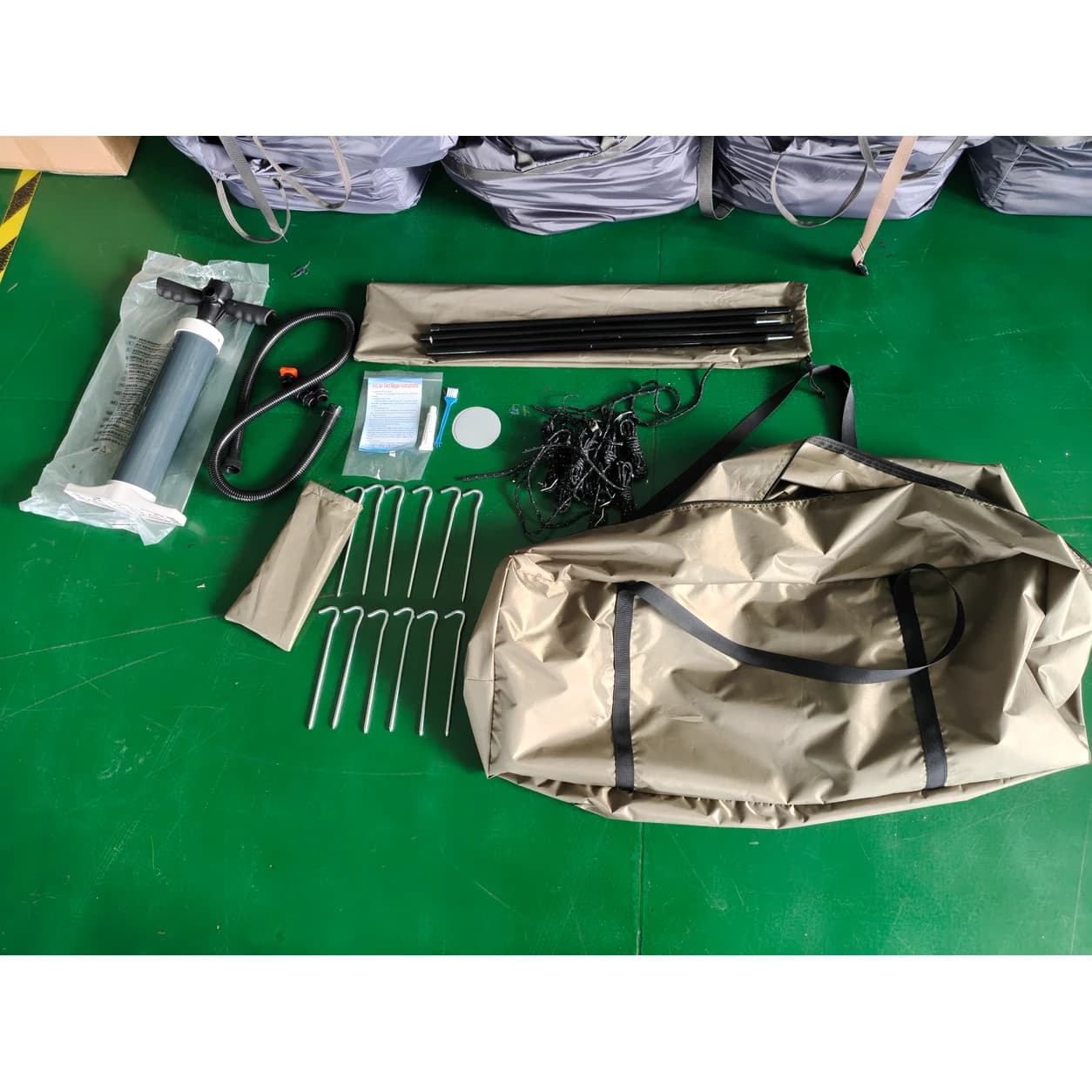
These are existing supplier catalogue images associated with SKU 54. The component view is not a confirmed packing list. The size graphic repeats catalogue dimensions and does not demonstrate usable interior space, capacity or performance.
A site worksheet with a bounded dimension example
Enter 230 × 200 × 120 cm only in the published-envelope field. Keep a separate field for measured interior landmarks and a third for the operator's available plot and circulation needs. Draw the proposed mattress or cot to its own documented outline, then mark whether the overlay has actually been reviewed on the selected tent version. Do not subtract an invented wall allowance or add a universal clearance. If entry, anchoring or operator requirements are unresolved, the worksheet should show that decision still open.
| Buyer supplies | Version-linked answer | Decision record |
|---|---|---|
| Market, site and proposed task | Selected SKU 54 option/revision and operating instructions | Which setting is being assessed, without claiming approval. |
| Available plot and circulation needs | Full pitched outline, guy/anchor positions and extensions | Whether a site/layout review can proceed. |
| Sleeping equipment and belongings | Usable inner measurements and a reviewed overlay/sample | Fit remains unconfirmed until the actual arrangement is checked. |
| Entry and operating task | Clear opening, door travel and assembly/pack sequence | Whether the requested operation is supported. |
| Project and document requirements | Applicable product records and operator/authority review | Separate product selection from permission to run accommodation. |
Five steps to a site-specific selection record
- 1Describe the taskState market, site, customer/operating task, quantity and the exact SKU 54 version.
- 2Map the published envelopeRecord the listed dimensions with units, landmarks and measured state.
- 3Request interior and full pitchKeep usable space, entry, anchor/guy positions and extensions as separate fields.
- 4Review a real arrangementCompare actual equipment, circulation and operating needs with the selected sample and operator's plan.
- 5Resolve or reject the optionRetain evidence and outstanding requirements; do not approve a use or permission from a catalogue name.
Separate selection guidance from project permission
REI's bivy guide distinguishes sacks and low-rise shelters and discusses restricted space and access. It does not identify SKU 54 as a bivy or transfer its weather, insect or thermal statements to this tent. Hilleberg's own selection guidance separately considers usable room, entrances and the extra pitching footprint of certain models. These guides support asking different spatial questions; their product capabilities and occupancy claims are not SKU 54 evidence.
The U.S. National Park Service advises checking campground rules and considering site boundaries and layout. That is U.S. park guidance, not a universal project spacing rule. The ISO committee page for ISO 18980, reviewed November 1, 2026, shows an October 2026 edition at stage 60.00, under publication, with a public scope covering campsite facilities and services. This is a current development to discuss with project reviewers, not a published SKU certificate or a statement of local legal compliance. Only the public abstract/status was reviewed, not a purchased full standard.
Original sources reviewed November 1, 2026
Review the sleep-pod record and send a site brief
Open SKU 54 and identify the chosen version. Send market, available plot, entry/operation task, proposed sleeping equipment and quantity, then request interior, full-pitch, contents and project-document records. Keep operator permissions separate.
Frequently Asked Questions
Does 4.6 m² tell me how many people fit?
No. The catalogue area label does not establish a usable inner floor, equipment layout or comfortable occupancy. Review those separately.
Is 120 cm a usable standing height?
Do not assume that. Ask what the listed height measures and request actual internal sections for the intended task.
Can I fit a mattress by comparing external lengths?
External lengths alone are insufficient. Use the selected mattress outline, measured interior and an actual layout/sample review.
Is the listed rectangle the complete site footprint?
Not necessarily. Request the pitched outline, anchor/guy positions, extensions and operating space, then apply the operator's site requirements.
Does PU3000 prove certification or project approval?
No. It is a catalogue fabric label here. Any complete-product performance or project approval needs its own applicable evidence.
Does ISO 18980 certify this tent?
No. The reviewed committee page describes a campsite facilities/services document under publication. It is neither a SKU 54 certificate nor proof of local permission.